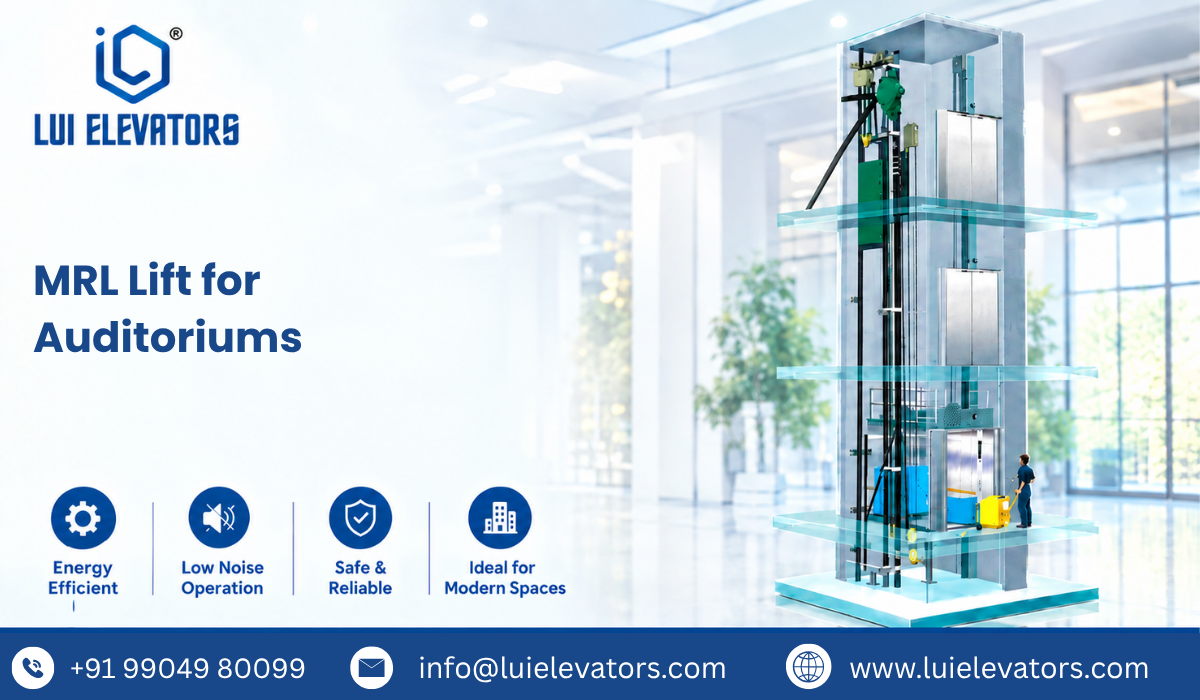
Modern auditoriums need more than impressive interiors and excellent acoustics. They also require safe, comfortable, and efficient vertical transportation for visitors, staff, performers, and service teams. An MRL Lift for Auditoriums is an excellent solution because its machine-room-less design helps save valuable building space while delivering smooth and reliable passenger movement.
Unlike conventional elevator systems that require a separate machine room, MRL technology integrates the compact traction machinery within the shaft or overhead area, depending on the design. This can provide greater architectural flexibility and a cleaner building profile.
For auditorium projects, where large crowds may arrive and leave within short periods, choosing the right elevator capacity, speed, door configuration, safety features, and cabin design is especially important.
Auditoriums experience unique traffic patterns. Before a show, during intervals, and immediately after an event, passenger movement can increase considerably. The elevator must therefore provide dependable performance without compromising comfort.
An MRL elevator eliminates the need for a conventional machine room, helping architects use available space more efficiently. Gearless traction technology can also provide smooth acceleration, controlled stopping, and quiet operation—valuable characteristics in buildings where passenger comfort and noise control matter.
For a new auditorium, this technology can also simplify architectural planning because there is no conventional rooftop machinery room to accommodate.
A well-designed auditorium elevator should combine technology, safety, aesthetics, and practical functionality.
The primary advantage is the compact arrangement of the traction equipment. Eliminating a separate machine room can free architectural space and provide greater flexibility for rooftop and building planning.
Auditoriums demand a comfortable passenger experience. Modern gearless traction systems are designed to provide controlled movement, reduced vibration, and quiet operation, making them suitable for theatres, cultural centres, performing-arts venues, and multipurpose halls.
Microprocessor-based controllers and VVVF drives can support smooth acceleration and deceleration, accurate floor levelling, and efficient elevator operation. Lui Elevators incorporates these technologies into its MRL solutions, subject to project specifications.
Automatic centre-opening or other suitable door configurations can make passenger entry and exit faster. Door dimensions should be selected according to expected traffic, cabin capacity, accessibility requirements, and the architectural layout.
Auditoriums often have distinctive architectural themes. Elevator cabins can be designed with stainless-steel finishes, attractive lighting, durable flooring, mirrors, handrails, and customized interiors to complement the venue.
Safety should remain the first priority. A suitable auditorium elevator may include door interlocks, emergency alarms, overload protection, emergency lighting, braking systems, communication facilities, and other applicable safety provisions.
India's elevator requirements are subject to applicable standards, regulations, and local authority requirements. Current specifications should be verified for the particular project; BIS and industry sources note the evolution of India's lift standards, including the newer IS 17900 framework.
Quality is not simply about the appearance of the cabin. It involves the complete elevator system—from the traction machine and controller to guide rails, doors, safety components, installation, testing, and after-sales service.
For an auditorium, buyers should evaluate:
Lui Elevators focuses on complete elevator solutions, including design, installation, maintenance, and modernization support. Its MRL traction gearless elevator is positioned for applications where space optimization, ride comfort, and reliable performance are important.
Selecting the manufacturer is as important as selecting the elevator technology. A reliable manufacturer should understand the building's traffic requirements rather than offering a standard configuration for every project.
Before finalizing the system, discuss passenger capacity, number of floors, travel height, expected traffic, shaft dimensions, pit depth, overhead requirements, power supply, accessibility, emergency operation, and interior requirements with the elevator manufacturer.
The MRL Lift Supplier for Auditoriums should also provide clear technical documentation, installation timelines, warranty terms, maintenance options, and service support.
The MRL Lift Price for Auditoriums varies according to the project's technical and architectural requirements. There is no single price suitable for every auditorium.
Important cost factors include:
Instead of selecting an elevator only by initial price, auditorium owners should consider lifecycle value, reliability, energy consumption, maintenance, and passenger experience.
Demand for advanced elevator systems continues across India's major commercial and cultural centres. MRL Lift for Auditoriums in Ahmedabad is particularly relevant for new theatres, convention venues, educational institutions, cultural centres, and commercial developments.
Lui Elevators can also serve projects across major cities such as
For developers searching for an MRL Lift for Auditoriums in India, selecting a manufacturer with appropriate technical expertise and dependable service support can make the complete installation process smoother.
Lui Elevators combines modern elevator technology with project-focused engineering. Its MRL solutions are designed to provide space efficiency, smooth travel, modern aesthetics, and dependable operation.
Whether you are developing a theatre, performing arts centre, educational auditorium, corporate auditorium, or large multipurpose venue, Lui Elevators can help evaluate the site and recommend an elevator configuration based on actual requirements.
For projects where design, passenger comfort, and efficient space utilization matter, an MRL system can be a practical choice.
MRL stands for Machine Room Less. It is a traction elevator configuration where the main traction equipment is integrated within the hoistway or designated overhead area rather than requiring a conventional separate machine room.
Yes. MRL elevators can be suitable for auditoriums when their capacity, speed, traffic handling, shaft dimensions, and safety requirements are correctly specified.
Yes. Depending on the selected configuration, cabin finishes, lighting, flooring, fixtures, doors, and other design elements can be customized to complement the auditorium's architecture.
Start by sharing your building drawings, number of floors, expected passenger traffic, shaft dimensions, and desired cabin specifications with an experienced elevator manufacturer. The manufacturer can then recommend the appropriate configuration and provide a project-specific quotation.
A modern auditorium deserves an elevator that matches its architecture, traffic requirements, safety expectations, and passenger experience. From space-saving construction and smooth traction technology to customized cabins and professional service, the right MRL system can add significant value to the building.
If you are looking to Buy MRL Lift for Auditoriums, contact Lui Elevators for a detailed consultation, technical guidance, and a project-specific quotation. Choose an elevator solution engineered around your auditorium—not simply a standard lift package.

+91 63570 09292
info@luielevators.com
D-16,20,21 Swarnim Industrial Park, Phase-2, Bakrol - Bujrang, Ahmedabad-382430