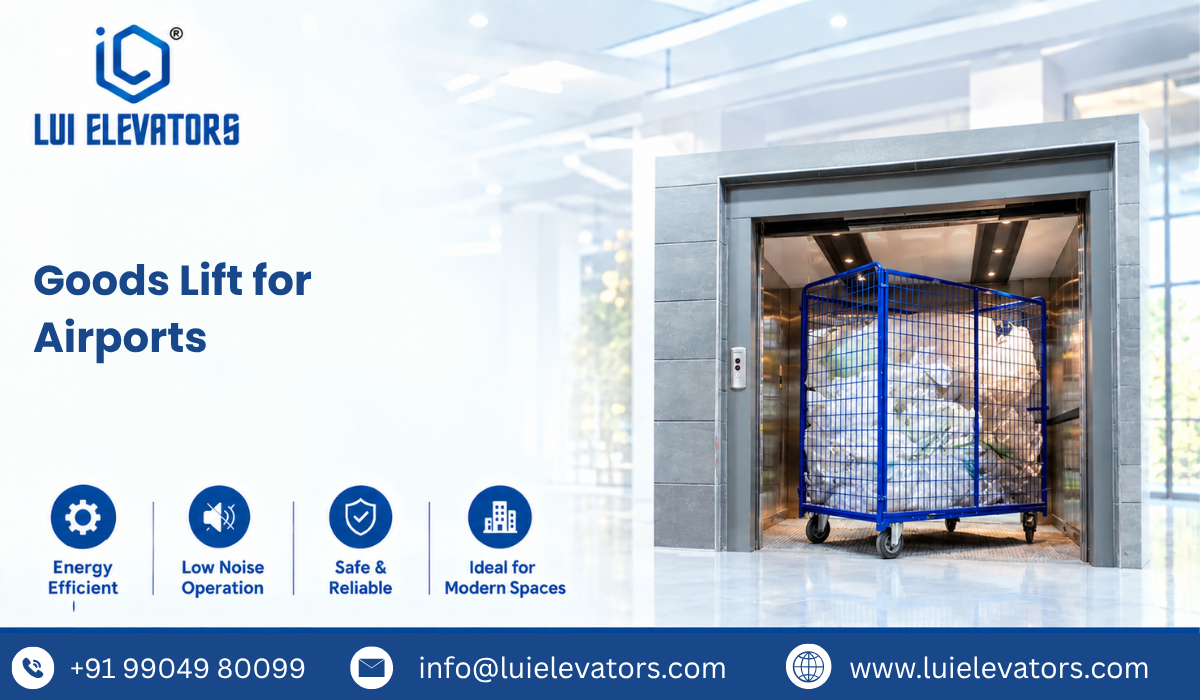
Airports are high-traffic environments where the smooth movement of luggage, cargo, supplies, maintenance equipment, food, and other materials is essential for uninterrupted operations. A reliable Goods Lift for Airports provides a dedicated vertical transportation solution for moving heavy or bulky goods between different levels of terminals, warehouses, service areas, kitchens, parking structures, and cargo facilities. Unlike passenger elevators, goods lifts are engineered to prioritize load handling, durability, and frequent operational cycles.
Lui Elevators offers engineered elevator solutions for commercial and industrial requirements, with goods lift configurations that can be customized according to load capacity, travel height, shaft dimensions, door arrangement, and application. For airport projects, selecting the right lift requires careful consideration of operational traffic, payload, safety requirements, installation conditions, and long-term maintenance.
An airport may need to move everything from packaged supplies and catering materials to maintenance tools and cargo containers. A Top Goods Lift for Airports should therefore provide dependable performance under demanding working conditions. The lift should be capable of handling repeated loading and unloading without compromising smooth movement or operational safety.
A properly designed goods lift can help airport operators separate passenger movement from service logistics. This improves workflow because staff can transport materials without occupying passenger elevators. It can also reduce manual handling across stairs or ramps, particularly when goods need to move between multiple floors.
When selecting a Best Goods Lift for Airports, buyers should evaluate more than rated capacity. Important considerations include lift speed, cabin dimensions, door size, loading method, landing configuration, control system, safety devices, structural design, and expected duty cycle.
Airport goods-handling applications can involve heavy loads and frequent operation. Therefore, the equipment should be selected with application-specific engineering in mind. Depending on the project configuration, important features can include:
The exact specifications should be determined through a technical assessment of the airport facility. Factors such as pallet sizes, trolley dimensions, cargo weight, available shaft space, number of floors, and operating frequency should be considered before finalizing the elevator.
For airport infrastructure developers looking for a Goods Lift for Airports in Ahmedabad, working with an experienced elevator manufacturer can simplify equipment selection, customization, installation, and after-sales support. Ahmedabad is an important industrial and commercial center with growing infrastructure requirements, making dependable vertical transportation increasingly relevant for logistics and commercial facilities.
A Goods Lift for Airports in India can be designed for different airport environments, including passenger terminals, cargo terminals, service buildings, warehouses, aircraft-support facilities, commercial areas, and multi-level parking structures.
Lui Elevators can support project requirements across major Indian markets, including
Choosing the right Goods Lift Manufacturer for Airports is important because airport elevators are part of an operational infrastructure system rather than simply standalone equipment. The manufacturer should understand the intended application and provide appropriate engineering recommendations.
A professional manufacturer should be able to evaluate:
The rated load should match the heaviest goods, trolley, pallet, or equipment expected to enter the cabin. Additional consideration should be given to how loads are distributed.
Airport logistics may involve large carts and equipment. Cabin dimensions and door openings should therefore be selected according to actual loading requirements.
A lift used throughout the day requires components and controls appropriate for its expected duty cycle. Frequent operation makes durability and preventive maintenance especially important.
Goods lifts should incorporate suitable safety systems, door interlocks, overload protection, emergency provisions, and other requirements applicable to the installation.
Quality is one of the most important considerations when selecting a Goods Lift Supplier for Airports. A dependable supplier should provide properly engineered components, controlled manufacturing, professional installation, testing, and ongoing service support.
Lui Elevators focuses on providing elevator solutions for different commercial and industrial applications. Project-specific customization allows the lift to be planned around the available shaft, required capacity, building layout, and operational requirements.
For airport projects involving procurement from outside India, an experienced Goods Lift Exporter for Airports should also be capable of coordinating technical specifications, documentation, packaging, logistics, and project communication according to the destination requirements.
The Goods Lift Price for Airports depends on several technical and project-specific factors. Capacity, speed, number of stops, travel height, cabin size, door type, control technology, materials, safety equipment, installation conditions, and customization can all influence the final cost.
Instead of comparing quotations based only on initial purchase price, airport authorities and contractors should consider total ownership value. Equipment reliability, spare-parts availability, maintenance support, energy consumption, warranty, installation quality, and long-term service can have a significant effect on operational costs.
A goods lift is primarily used for transporting materials, supplies, equipment, luggage-related items, maintenance goods, catering supplies, and other heavy or bulky loads between different building levels.
Yes. Capacity, cabin dimensions, door arrangements, finishes, controls, and other specifications can be planned according to the building and material-handling requirements.
Yes. Goods lifts are generally designed around heavier loads, larger goods, durable construction, and specific material-handling requirements. Passenger elevators are primarily designed for people and passenger comfort.
To Buy Goods Lift for Airports, provide the elevator manufacturer with details such as required capacity, number of floors, travel height, shaft dimensions, cabin size, door configuration, and intended goods or trolley type. The manufacturer can then recommend a suitable configuration and prepare a project-specific quotation.
Lui Elevators provides elevator solutions for commercial, industrial, residential, and specialized applications. Its focus on engineering, customization, quality components, safety, installation, and after-sales service makes it a suitable partner for organizations seeking dependable vertical transportation solutions.
Whether you are developing an airport terminal, cargo facility, warehouse, service building, or airport-support infrastructure, the right goods lift can improve logistics efficiency and reduce unnecessary manual movement.
Contact Lui Elevators today to discuss your airport goods-handling requirements. Share your load capacity, shaft dimensions, number of floors, and application details to receive professional guidance and a customized goods lift solution for your project.

+91 63570 09292
info@luielevators.com
D-16,20,21 Swarnim Industrial Park, Phase-2, Bakrol - Bujrang, Ahmedabad-382430